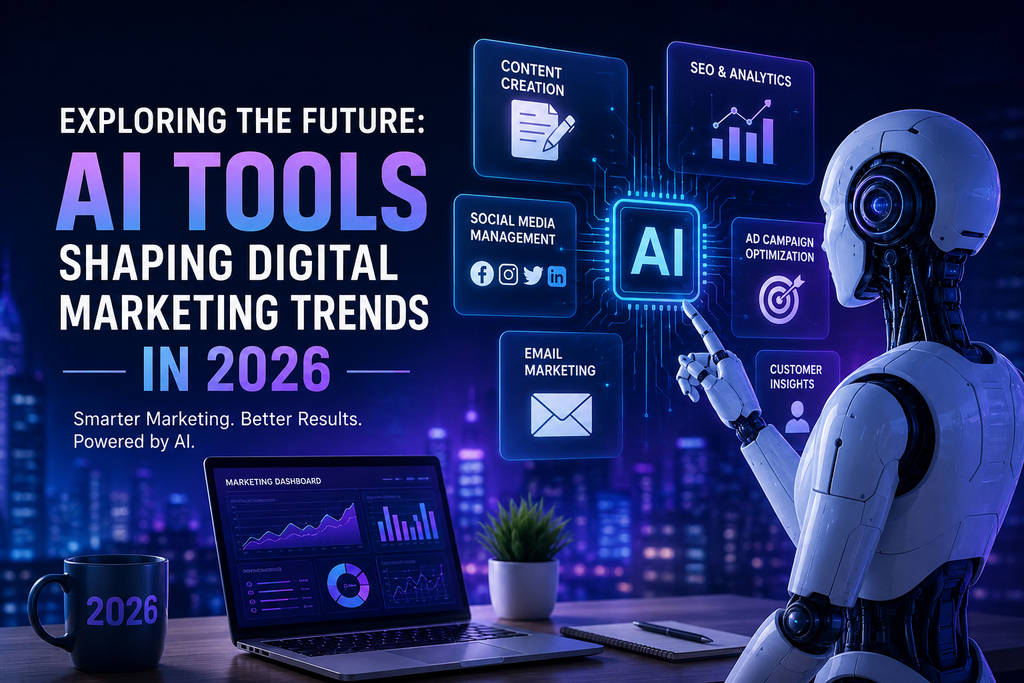
Artificial intelligence is no longer just a technology of the future. In 2026, it has become an important part of how businesses plan, create, promote, and measure their digital marketing campaigns.
From generating content and finding SEO opportunities to personalizing customer experiences and optimizing advertising campaigns, AI tools for digital marketing are helping marketers save time and make better decisions.
But AI is not simply about automation. The real opportunity is using artificial intelligence to understand customers, identify patterns in data, and create more relevant marketing experiences.
So, what does the future of digital marketing look like with AI? Let’s explore the key AI digital marketing trends in 2026, the tools marketers are using, and practical ways businesses can integrate AI into their strategies.
What Are AI Tools for Digital Marketing?
AI tools for digital marketing are software solutions that use technologies such as machine learning, natural language processing, predictive analytics, and generative AI to support marketing activities.
These tools can help businesses with:
- Keyword and SEO research
- Content creation
- Social media management
- Email marketing
- Paid advertising
- Customer segmentation
- Chatbots and customer support
- Data analysis
- Lead generation
- Marketing automation
The goal is not to remove the human side of marketing. Instead, AI can take care of repetitive and data-heavy tasks while marketers focus on creativity, strategy, storytelling, and customer relationships.
Why Is AI Important in Digital Marketing in 2026?
Digital audiences are becoming more demanding. People expect brands to provide relevant content, quick responses, personalized recommendations, and useful information.
At the same time, marketers have to manage multiple platforms and large amounts of data.
This is where AI in digital marketing becomes valuable.
AI can process large datasets quickly, identify customer behavior patterns, automate repetitive workflows, and provide insights that can support marketing decisions.
For a small business, this can mean saving hours every week. For a larger organization, AI can help manage marketing activities across multiple channels at scale.
7 Major AI Digital Marketing Trends in 2026
1. AI-Powered Content Creation
Content marketing continues to be an important part of digital marketing, but producing high-quality content consistently requires time.
AI content creation tools can help marketers brainstorm topics, create outlines, develop social media captions, write email drafts, generate video scripts, and repurpose existing content.
However, AI-generated content should not simply be published without human review.
A strong content strategy combines AI efficiency with human expertise. Marketers should add original insights, examples, brand personality, and fact-checking to make content genuinely useful.
2. AI SEO and Smarter Search Optimization
SEO is also evolving with artificial intelligence.
Modern AI SEO tools can help marketers discover keyword opportunities, analyze competitors, understand search intent, identify content gaps, and optimize existing pages.
Instead of focusing only on repeating a keyword, marketers should create comprehensive content that answers the user’s actual question.
For example, if someone searches for “AI tools for digital marketing,” a useful article should explain what these tools are, how they work, their benefits, examples of use cases, and how businesses can choose the right solution.
This approach creates a better experience for both users and search engines.
3. Hyper-Personalized Marketing
Customers do not all have the same needs.
AI can analyze customer interactions, browsing behavior, purchase history, and engagement patterns to help businesses create more personalized marketing experiences.
For example, an e-commerce brand can recommend products based on previous activity. An email campaign can also deliver different messages to customers depending on their interests or stage in the buying journey.
This makes personalization more scalable than traditional manual segmentation.
4. AI-Powered Advertising
Paid advertising is another area where AI is changing the marketing process.
Advertising platforms use machine learning to analyze signals, identify potential audiences, optimize bidding, and improve campaign delivery.
Marketers can also use AI tools for marketers to generate ad variations, analyze campaign performance, test messaging, and identify opportunities for optimization.
However, automation does not mean marketers should stop monitoring campaigns. Budget, targeting, creative quality, and business goals still require human oversight.
5. AI Chatbots and Conversational Marketing
Customers increasingly expect fast answers.
AI-powered chatbots can respond to frequently asked questions, guide website visitors, collect lead information, recommend products, and provide basic customer support.
For businesses, this can reduce response times and allow teams to focus on more complex customer queries.
The best chatbot strategy is not necessarily to automate every conversation. Instead, businesses should create a smooth transition between AI assistance and human support when a customer needs personal attention.
6. Predictive Analytics and Customer Insights
Traditional analytics often tells marketers what happened.
AI-powered predictive analytics can help businesses identify what may happen next.
For example, AI can help identify customers who are more likely to convert, recognize patterns in customer behavior, and highlight campaigns that may require attention.
These insights can support better decisions about budgets, audiences, offers, and customer retention.
7. AI-Generated Video and Visual Content
Video has become an essential part of social media and online advertising.
AI-powered creative tools can assist with video scripts, storyboards, captions, subtitles, voiceovers, image generation, and content variations.
This allows marketers to experiment with more creative concepts without starting every asset from scratch.
However, the quality of the idea still matters. AI can speed up production, but a strong marketing message requires understanding the audience and the brand.
How AI Is Transforming Digital Marketing Automation
One of the biggest advantages of AI is digital marketing automation.
Marketing teams regularly perform repetitive activities such as:
- Scheduling social media content
- Sending email sequences
- Organizing leads
- Creating reports
- Analyzing campaign data
- Segmenting audiences
- Following up with prospects
AI-powered automation can streamline many of these activities.
For example, when a potential customer submits a form, an automated workflow can record the lead, categorize it, send a relevant email, and notify the sales team.
This allows marketers to spend less time on repetitive work and more time developing strategies.
Benefits of Using AI Marketing Tools
Save Time
AI can complete repetitive tasks quickly, helping marketing teams work more efficiently.
Improve Personalization
AI can analyze customer data and help businesses deliver more relevant content and offers.
Make Better Data-Driven Decisions
AI can identify patterns in large datasets and provide insights that may be difficult to find manually.